
Drass, June 16, 2026: Government Degree College (GDC) Drass collaborates in Research Field Study being conducted under the joint ISRO–NASA NISAR (NASA–ISRO Synthetic Aperture Radar) Mission project focused on monitoring permafrost and rock glaciers in the Western Himalaya.
This collaboration marks the first-ever participation of GDC Drass in an ISRO–NASA NISAR Mission-related field research programme, reflecting the institution’s growing engagement in nationally significant scientific initiatives. The programme has enabled students and faculty members to work alongside eminent researchers and contribute to studies that have important implications for understanding climate change and cryosphere processes in the Himalayan region. The project, funded by the Indian Space Research Organisation (ISRO), involves collaboration among leading institutions including Azim Premji University Bangalore, ISRO, the Geological Survey of India (GSI), the Indian Institute of Science (IISc) Bangalore, JIS University Kolkata, and researchers from Austria.
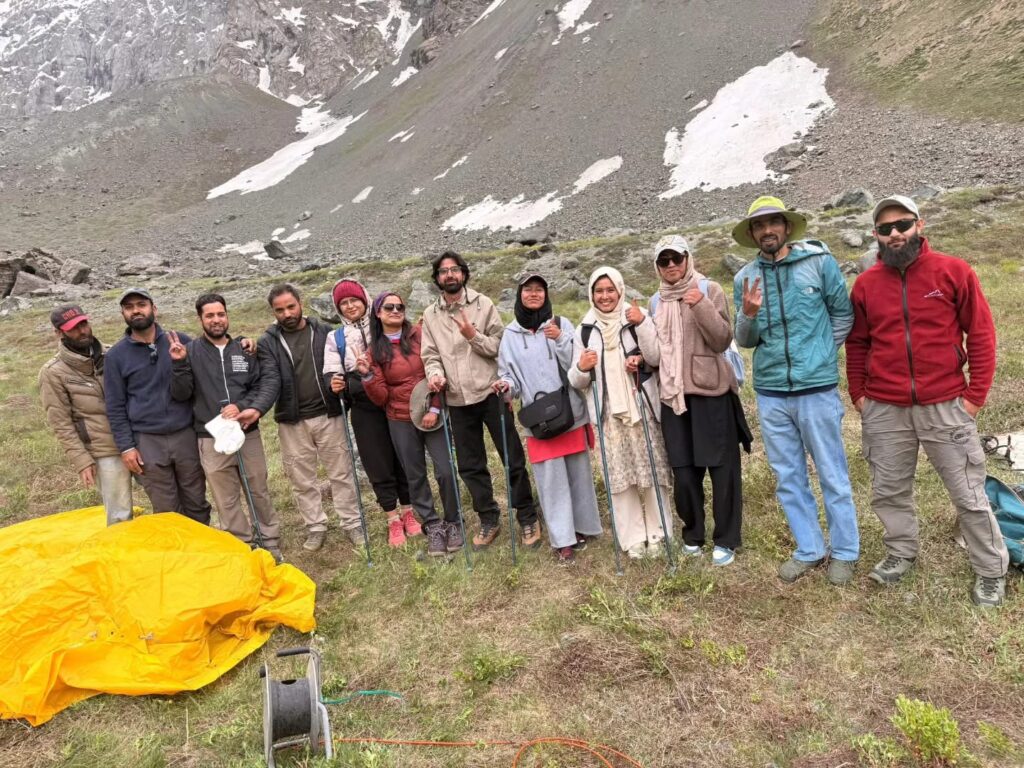
Today, the research team conducted an extensive field visit to the Lasar La Glacier in the Drass region to undertake detailed scientific observations and data collection related to glacier dynamics, permafrost conditions, and associated geomorphological features. The field investigations were carried out under the guidance of distinguished scientists including the field investigations were carried out under the guidance of a multidisciplinary team of experts including Dr. Remya S. N. (Assistant Professor, School of Climate Change and Sustainability, Azim Premji University, Bengaluru; expert in Himalayan glaciers and permafrost), Dr. Manisha Mishra (Assistant Professor, School of Climate Change and Sustainability, Azim Premji University, Bengaluru), Dr. Ayaz Mahmood Dar (Indian Institute of Science, Bengaluru), Er. Aadil Saleem Bhat (Research Scholar, Department of Civil Engineering, National Institute of Technology Srinagar, specializing in Geotechnical Engineering), and Dr. Mohmad Ashraf Ganaie (M.Sc. Applied Geology, M.Tech. Exploration Geoscience, Ph.D. in Rock Engineering and Geoscience), who collectively contributed their expertise in glaciology, permafrost studies, engineering geology, rock mechanics, geomorphology, and climate change research. The research team was also assisted throughout the field expedition by Mr. Suhail Ahmad, Trainer from the Department of High Altitude Trekking Guide of GDC Drass, whose expertise and support were invaluable during the trek to the glacier site.
Representing Government Degree College Drass, Dr. Shoib Maqbool and Dr. Mohsin Ahmad actively participated in the fieldwork along with students of the Department of Geology. Notably, students of the 6th Semester Geology programme were also part of the field team and were provided with valuable hands-on training and field exposure in glacial and periglacial environments.
During the field excursion, students were introduced to the fundamentals of glacier studies, identification of glacial landforms, rock glacier mapping, permafrost monitoring techniques, and the application of modern geospatial and remote sensing technologies in Himalayan research. The interaction with scientists from premier institutions offered students a unique opportunity to gain practical insights into contemporary research methodologies and climate change studies.
The Department of Geology expresses its heartfelt gratitude to the Worthy Principal, Mr. Nasir Shabani, for his continuous encouragement, visionary leadership, and unwavering support in facilitating this collaboration. The Department believes that such initiatives greatly enhance the academic and research capabilities of both faculty and students while strengthening the college’s association with premier scientific institutions.
The Department also extends its sincere thanks to the visiting scientists and collaborating institutions for providing this exceptional learning and research opportunity. Such collaborative efforts are expected to pave the way for future research partnerships and advanced studies in geology, glaciology, climate science, and environmental sustainability in the Drass region.
The field campaign will continue over the coming days, during which the research team, in collaboration with the Department of Geology, Government Degree College Drass, will explore and investigate additional glacier and permafrost sites across the Drass region and adjoining areas. These surveys will focus on identifying and documenting new glacier locations, rock glaciers, and periglacial landforms using advanced field techniques and geospatial technologies. The continued collaboration is expected to generate valuable scientific data for understanding the impacts of climate change on the Himalayan cryosphere while providing further opportunities for faculty members and students of GDC Dras to participate in cutting-edge field research and gain practical training from experts associated with the ISRO–NASA NISAR Mission project.